Next stop is Lymington
I reached Loctudy, a quaint fishing port and seaside resort in Brittany. This is a short distance east of where I would turn first northwest then north to reach for the UK coast. I was at Lorient for one night where Simon Curwen was nice to meet me at the fuel dock, then helped me tie up at my assigned berth. I arranged for Plastimo to take my life raft for service; they are the only ones authorized to handle this GGR specific life raft. I was going to wait at Lorient until better weather; however, I decided that if I moved the boat farther west, I could take advantage of short weather windows to escape the coast of Brittany. Loctudy is about 35M west of Lorient and just 18M east of where my course will turn NW.
You can monitor my progress and surrounding wind conditions using [TRACKING] in the menu. The weather has been atrocious, with more threatening conditions forecast in the British Channel for Thursday and Saturday. Sunday morning seems to be the earliest that I can relaunch from Loctudy toward Lymington. I will have about 300M, perhaps two and a half days of sailing to do. What makes these conditions difficult for small boats, is the potential for wind against current scenarios. Every six hours, the tidal currents shift in the Channel, making for challenging navigation. So, timing my crossing with less wind will help.
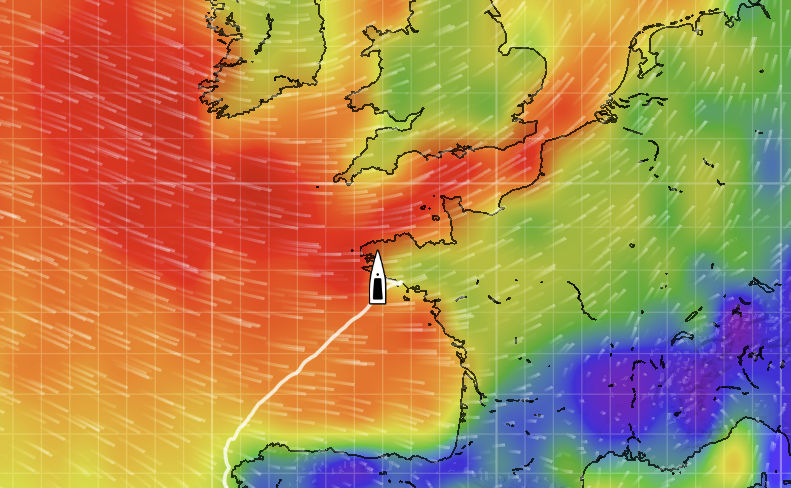
Forecast for midday Thursday (tomorrow).
I left Portimão on May 12. Pete Keeping and his Rigging Portugal team were there to help untie my lines. When I arrived at Portimão after months of delays at another location, Pete Keeping became my ally. He introduced me to Slick Hull Yacht Services and to stainless shop RGINOX in the same complex. They all rallied to make up for lost time so that I could carry on to UK to resume my Golden Globe Race campaign. Critical work was completed on time and professionally, with many improvements. I am grateful for their diligence.
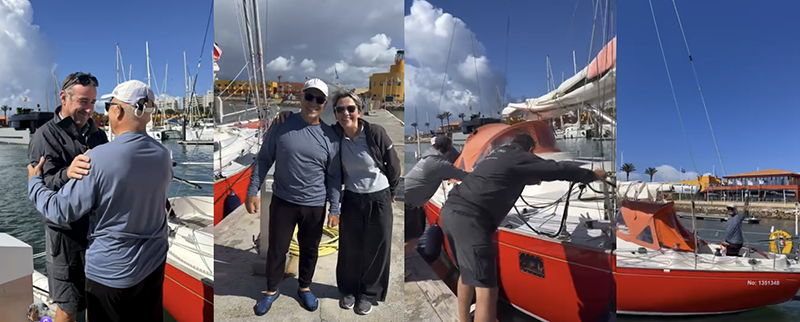
Pete Keeping, Eva Koch and Sebastian helped me depart from Portimão. They may join Nancy and my friends during the sendoff at Les Sables-d’Olonne on September 6th. That will be such a treat…
When conditions proved slow and the forecast showed opposing winds along the Portuguese coast, I decided to pull into Lagos to wait. I must admit that the familiar had its draw. In hindsight, I should have motor sailed for a day to reach Sines around Cabo de São Vicente on the west coast.
From Lagos, I proceeded on May 17th due WNW in order to latch on to a southwesterly wind regime that could help me rise north. Try as I might, the wind line kept retreating as I reached for it with the forecast showing a big wind hole in its place. Seeing that I would have to keep running my engine, I turned east toward Cascais just west of Lisbon to refill my fuel tank.
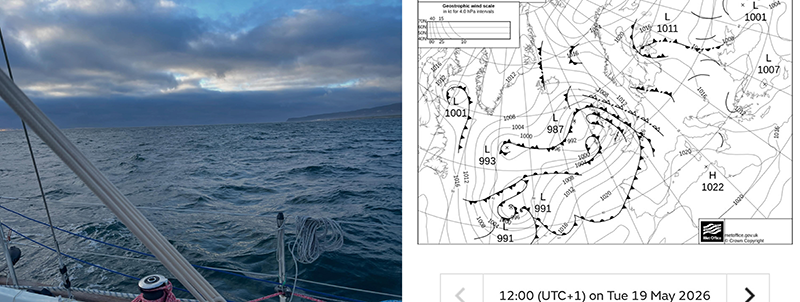
A cold front passed over Cascais while I waited there for two nights.
From Cascais onward I either had no wind or opposing winds with little opportunity to use my sails. No wind meant that my Hydrovane could not help, so I was committed to sit at the tiller all the time. This was not sustainable. I stopped at Figueira da Foz for one night to catch up on my sleep and topped up my fuel.
Pigeon Racing (e.g. Algarve Golden Race) is a traditional pastime in Portugal. At about 15M southwest of Viana do Castelo around noon on 24 May, a wayward homing pigeon appeared by my boat and decided to land on my dodger. She had bands on both ankles, so she had an owner. Nearest land was 14M due east. I let her settle, fearing that any sudden movement would scare her off to certain death over open ocean with no landmarks. She should have been able to navigate by the sun, but I did not want to take any chances. With slow deliberate movements, I went into the cabin and put some water in a bowl to offer. I reached slowly to get her beak wet, and she dunked her whole beak in to drink gulps of water. It had to have been circling over water in frustration.
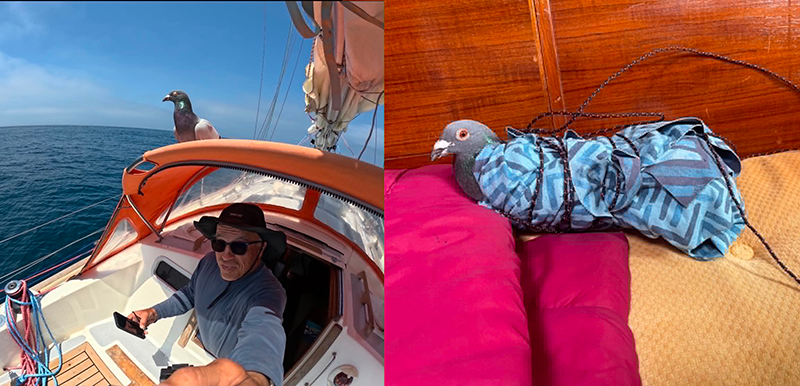
This banded pigeon had been handled before. It did not resist when I wrapped my hands around its wings to take her inside. I loosely swaddled her in my towel to keep her from injuries trying to fly in the cabin.
When I reached Vigo the next day at dawn, I was tempted to look for a responsible person to take over this pigeon to locate its owner in Portugal. She drank more water however I had not been able to feed her; time was not in her favor. In the end, I decided that I should trust the legend that a homing pigeon will find her path home. She was free to roam back to her own coop.
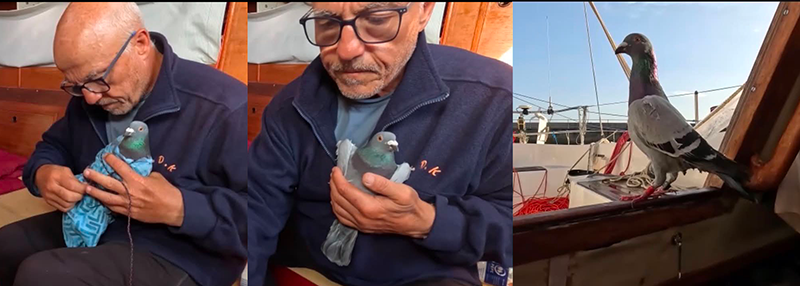
She had soiled herself inside the towel, I wanted to rinse her, but she was anxious to depart. When she wiggled her way out of my loose embrace, I did not react for fear of causing injury. She flew up on the mainsail which was by then folded down on my boom. She stayed there perhaps another hour before taking off.
There is a slow water ingress that I noticed in the deep bilge under the engine. I was not able to identify an obvious source like a seacock or a hose; my suspicion was on the shaft and its housing. When I left Lagos, the main bilge pump would turn on occasionally and would not stop. It seemed that the float installed for the pump was too low, so when the pump extracted all the water that it could, the float would still be sitting in low water especially on port tack, engaging the pump.
I used the end of my boat hook to reach in to keep the float down, then I lifted it periodically to pump out. The rate of ingress was about 15 cm per day. After a few days, that patch solution stopped working; I could not run the main bilge pump at all. I had initially planned to continue until Puerto de Muros closer to Cabo Finisterre to refuel. I diverted instead 40M earlier to Vigo both to release the pigeon and to find a solution to my bilge pump issue. I found a chandler for parts. I proceeded to devise a small bilge pump to vacate the bilge.
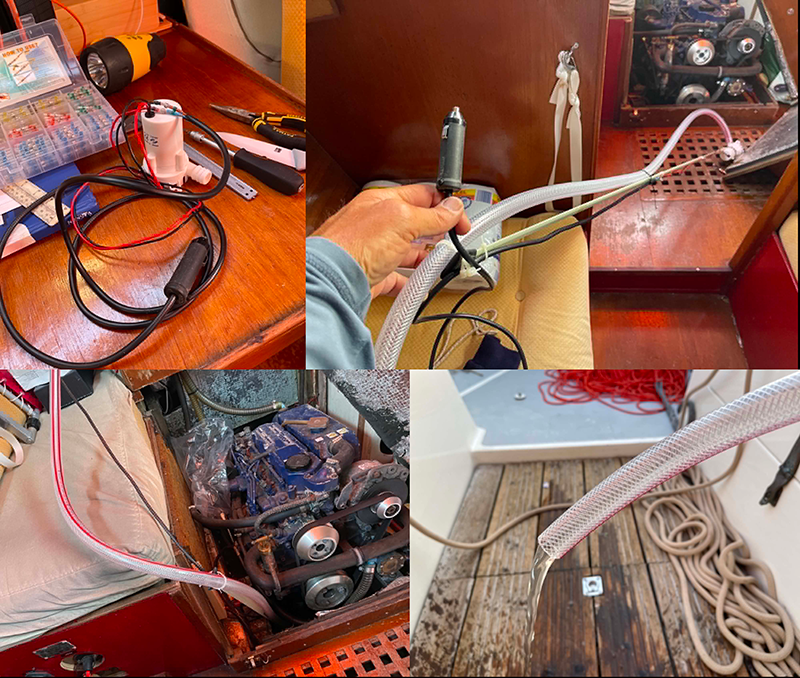
I bought a small bilge pump that I could run using a 12V jack. I attached that at the end of one of my sail battens, then I extended the contraption into the bilge. The batten guided the power cable and a 4-meter hose out of the bilge.
My temporary solution was sufficient encouragement to cross the Bay of Biscay which is notoriously feisty. I did not lose time at Vigo and continued motor sailing toward Lorient. The bilge pump issue will be among the priorities to address at Lymington. The reason for moving CLARA to UK is for me to exit the Schengen Zone given visa restrictions that I was facing. I will be at Lymington until the second half of July.
I wanted to stop at Lorient to deliver my GGR specific life raft to Plastimo where they have their authorized workshop. The raft has electronic devices inside like a PLB and an AIS transmitter, both of which have to have their batteries serviced to be valid through the summer of 2027. Servicing the raft in the UK or dealing with shipping it to France after Brexit could mean more complications, I did not want to take any chances.
When I reached Lorient on Sunday the 31st, Simon Curwen came to meet me at the fuel dock, I topped up on fuel then we moved my boat to her assigned berth. It was good to catch up and to give him a summary of all the refit and improvements done to S/V CLARA. His suggestion on the ingress was to press more grease into the shaft housing; “apply more grease every 500M under engine,” he commented.
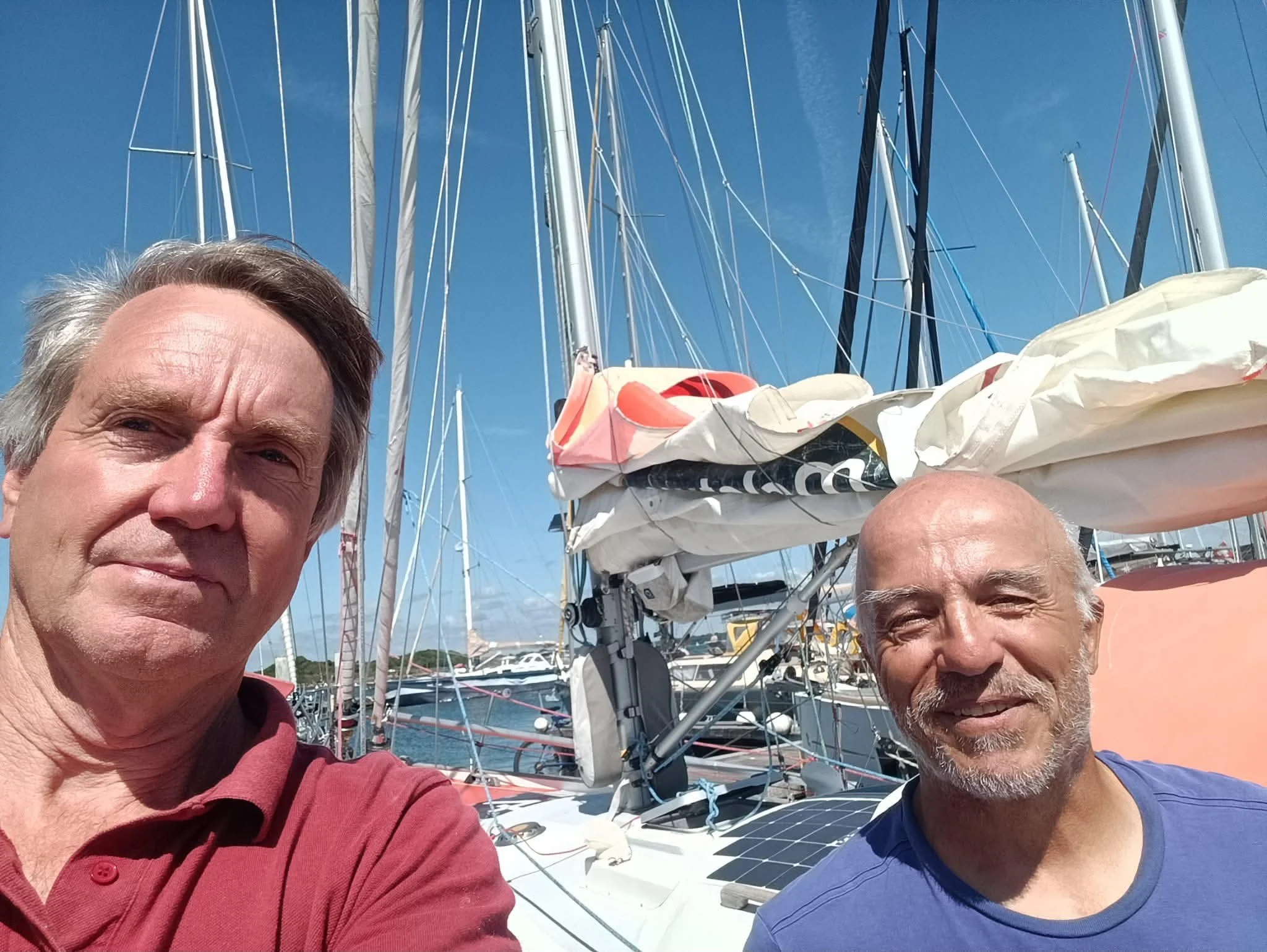
It was wonderful to meet Simon Curwen once more. He was the first to arrive back at Les Sables-d’Olonne in the 2022 race on S/V CLARA. With his unfortunate windvane failure, he had to divert to Puerto Montt in Chile while leading the race. That single stop cost him 10 days to receive a replacement part, before repairing and rejoining the race. He turned Cape Horn in fourth place and still caught the leaders, earning him 1st place in Chichester Class.
There is a grease dispenser inside the cockpit side locker with a screw handle to drive its plunger. I had turned that handle until I met resistance. When Simon pulled the plunger out of the dispenser to investigate, he found the grease solidified inside. He poked it with a chopstick to break it down, then screwed the cap back on and forced some grease into the shaft housing. One had to apply a lot more force than I had been, enough to hurt one’s hand in doing so. I was praying that in the process we would not break the handle, or the hose between the dispenser and the shaft!
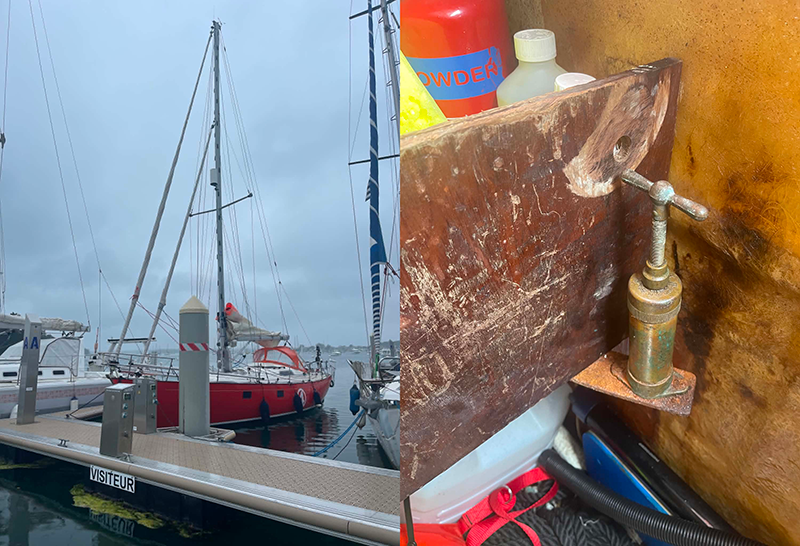
The move to Loctudy was wise to take advantage of short weather windows to turn the corner toward the UK. I made sure to press more grease into the shaft housing by torquing the screw handle of the dispenser, turning the shaft in forward and reverse and pressing some more. It offered quite a resistance given the thick consistency of the grease. This slowed the ingress considerably.
The forecast showed milder conditions on Monday and Tuesday before more severe conditions would prevail in the Channel. As a tactical decision, I decided to position CLARA farther west, so I mobilized on Monday after only a night of rest at Lorient. When I reached Loctudy by late afternoon, the marina was reasonably sheltered from the winds. That is changing now.
Tomorrow (Thursday) and Saturday will bring fierce winds here and to the British Channel. The earliest that I will launch should be Sunday morning. I am continuing to monitor the forecast and seeking input from my weather guru friend Jason Christensen.