Preparing for Portimão
I made it back to Redmond from Europe on the day before Thanksgiving. There was peace again at home with Nancy and Buddy on my side. Sleeping in my own bed was bliss although I kept waking up at 4 a.m. for days until I adjusted to the new time zone.
I had traveled to Lagos mid-October then struggled with scheduling of tasks on CLARA. Even though I had notified the boatyard with the dates that I would be there, the technicians remained busy with other work. Time was not a luxury that I had; waiting around while burning days on my Schengen visa was frustrating. Fortunately, the electrical work started before I left for a week to attend my Medical First Aid course at the Medical Safety Offshore (MSOS) facilities in Southampton. When I returned to Lagos, the marine electrician Dhiogo made sure to complete his work.
I needed better designed chainplates manufactured and installed before I could take CLARA out to demonstrate proper use of my jury-rig sailing kit. The kit includes two identical spinnaker poles and all necessary lines, blocks and shackles to setup an A-frame in case of dismasting. The Notice of Race specifies the following: "A jury rig trial, once approved, shall be conducted on the entered boat with the main mast and all standing rigging removed, then assembled at sea, solo, sailing for a minimum of 5 hours on a triangular course with 3 nm per leg (one leg shall be on a beam reach) in the open ocean with winds greater than 15 knots."
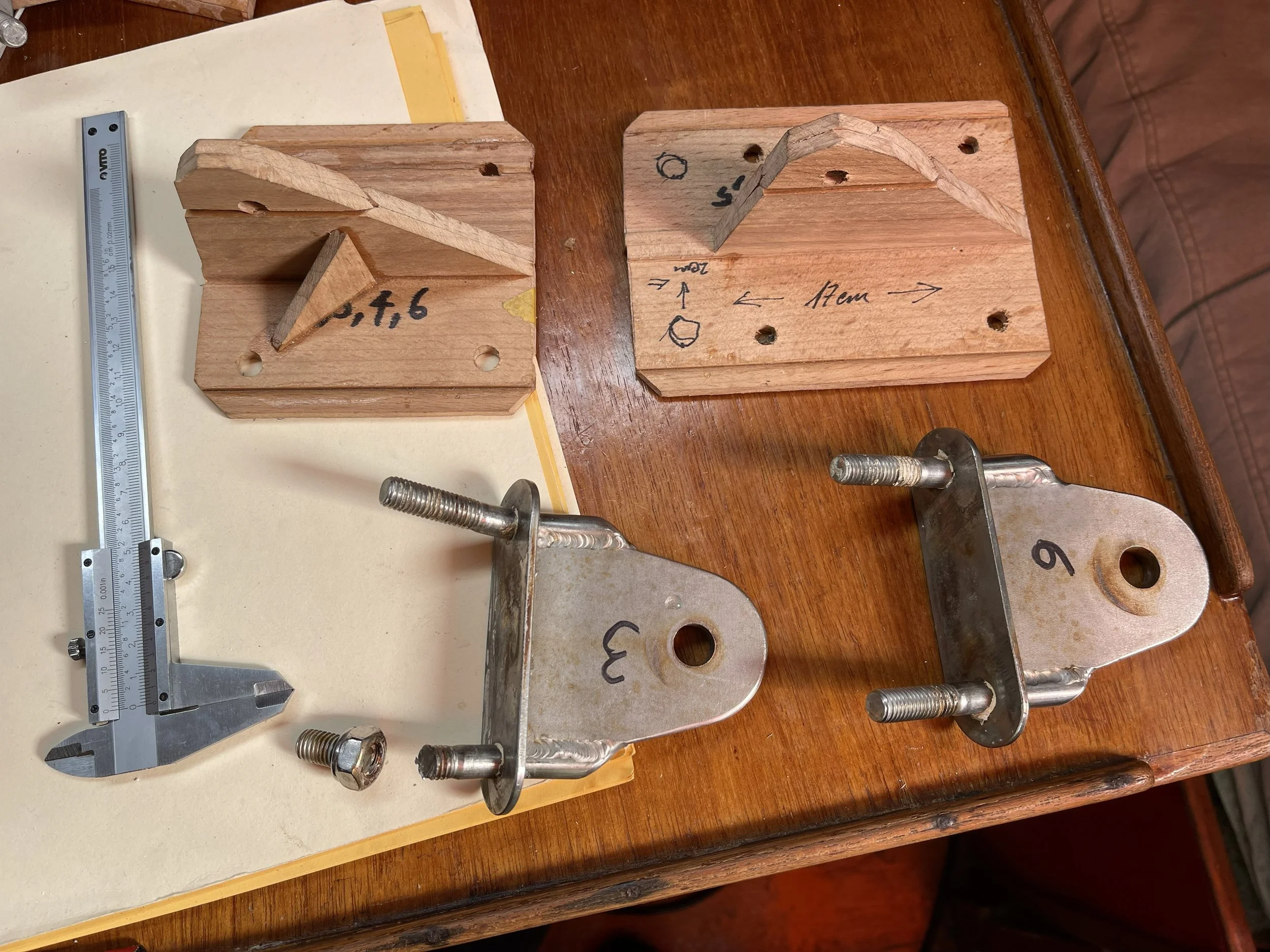
The original chainplates had welded 10mm screws. The broken screw made that chainplate irrepairable while underway. To facilitate visualization of the parts to manufacture, I made wooden models.
I had removed the original chainplates back in March after returning to Lagos from my 4700M solo qualification sail. The replacement chainplate work did not start until the week before I left Lagos this November. We were finally able to complete the above deck components on the last day that I was there, however the L-brackets to bolt below deck had not been finished. As such, I had to postpone installation of the chainplates and the jury rig trial sail until I returned there in 2026.
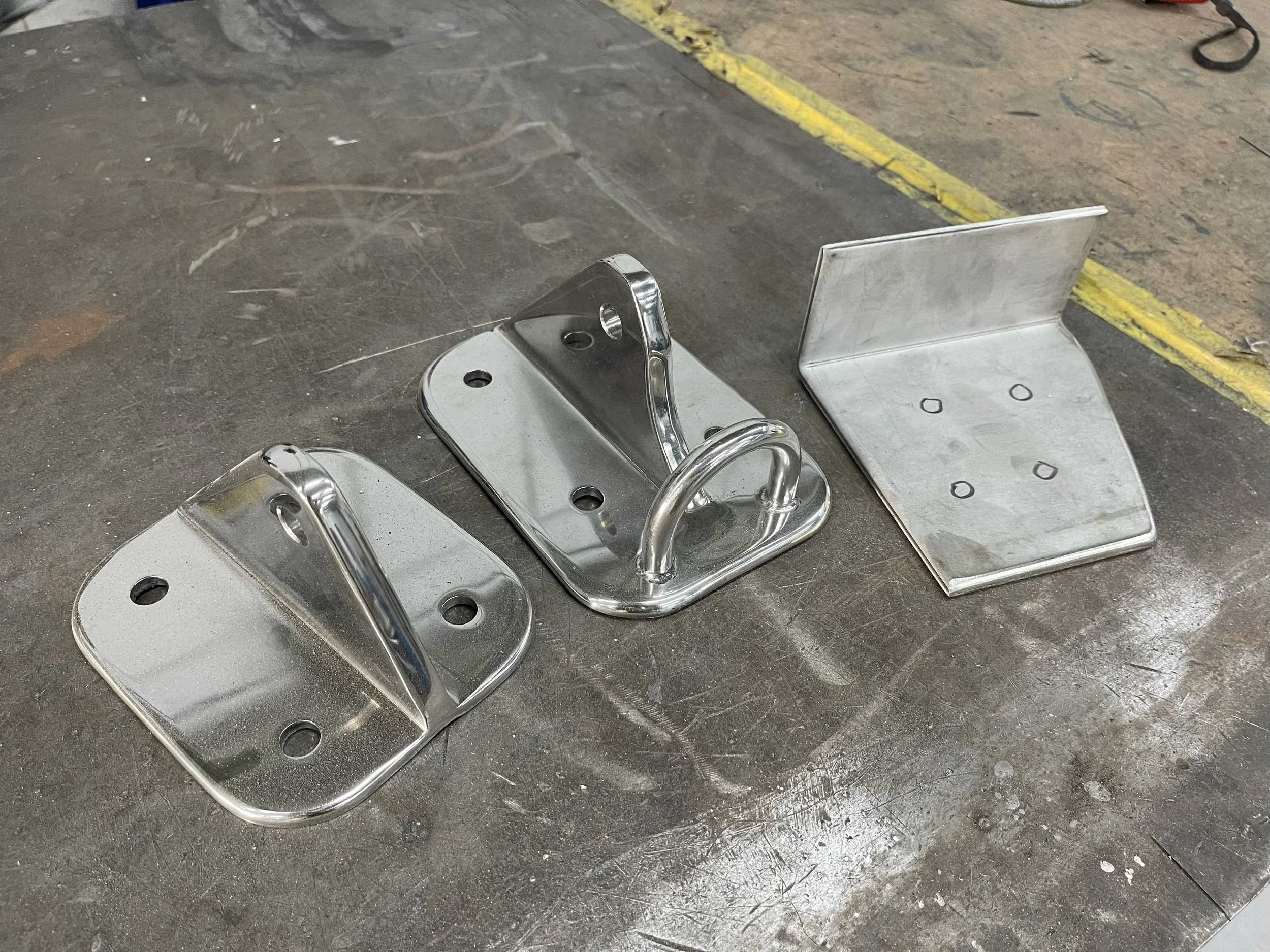
The new chainplates will use four 12mm thru-bolts to secure them to L-brackets below deck. The above deck components were finished when I left, the L-brackets needed more work. The chainplate on the very left will hold one of the four diagonal shrouds which reach halfway up the mast. The middle one will receive the vertical shroud from the spreader; it has a loop where I can attach the spinnaker pole to construct the A-frame for the jury rig in case of dismasting.
My next stop was in France for an official skippers meeting. The GGR skippers were to gather at Les Sables d'Olonne for an exciting three-day program to review the calendar of requirements and the necessary preparations. I allowed a few more days around our scheduled meeting dates in the hope that some skippers would want to spend extra time together in this special town. Granted that it was mostly mid-November gray skies and rain, LSO remained interesting as it is the heart of shorthanded offshore sailing, being the venue for important races including Vendée Globe, Vendée Arctic and Mini Transat.
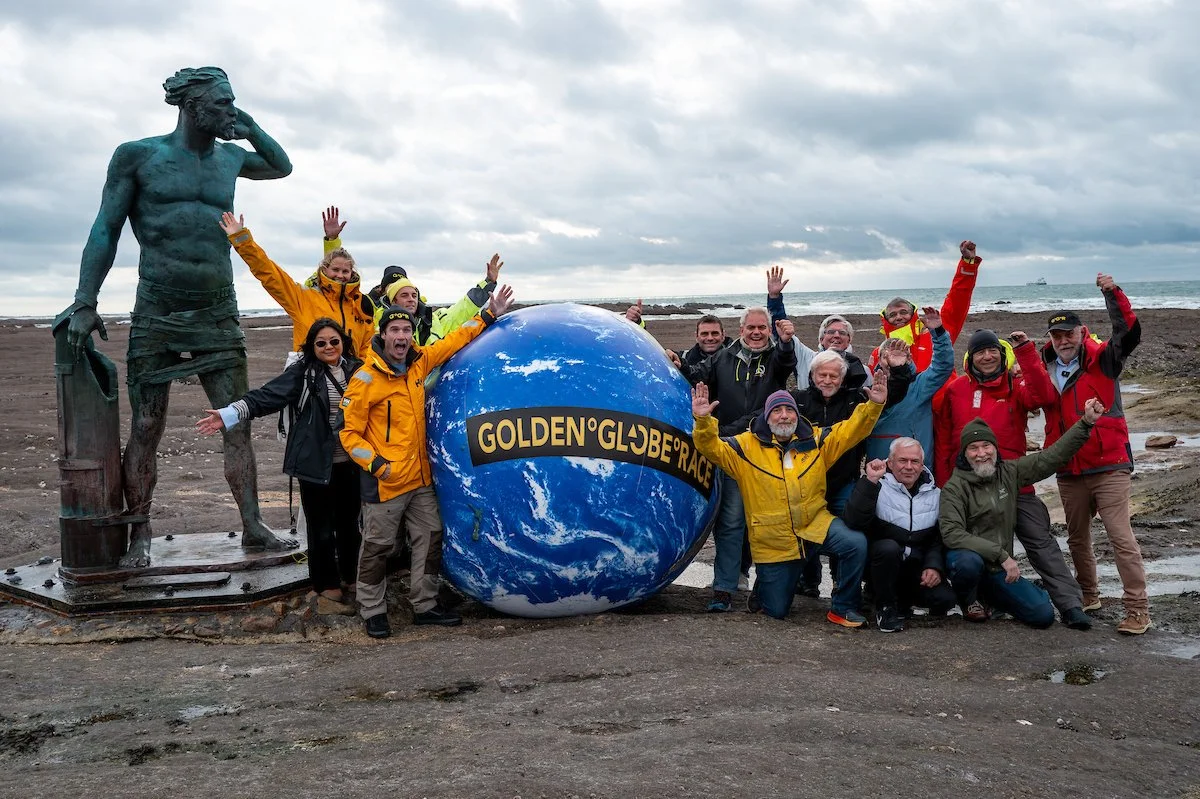
2026 McIntyre Golden Globe entrants with organizers Don McIntyre & Jane Zhou with the statue of Ulysses at LSO.
My plan is to return to Lagos on January 25th. Soon after I get there, we will lift the mast and the boom off the concrete then secure them horizontally on the deck. The lift-in is scheduled on January 30th. After verifying reliable performance of the engine, weather permitting, I will motor from there about 30M east to Portimão. That is a larger port with multiple independent maritime workshops to which I can distribute the remaining tasks. I already have the word from Pete Keeping Lda that they scheduled my standing rigging work for the first week in February. They will also receive the mounts for a second Hydrovane.
Simon Curwen had to stop at Puerto Montt in Chile during the 2022 GGR to replace a broken cast metal piece on his wind vane. Others including Sir Francis Chichester in 1967, had their share of issues with wind vanes sacrificing their nonstop status. So, I decided to race with a dual Hydrovane setup even though this would mean added weight on the transom. I will remove the existing vane then fill the bolt holes for its mounts. Once we finish the hull repaint, I will reposition the old Hydrovane such that the two drive units will be about 14 inches apart. I will obviously use only one Hydrovane at any given time. If the primary one fails, then I will move its rudder blade and vane over to the spare drive unit then carry on. My hope is that this redundancy will ensure my nonstop completion of the race.
I already made the travel arrangements to attend a weeklong Proficiency in Medical Care training at Southampton starting on February 9th. This will complete my medical competency requirements after which I will be entrusted with a comprehensive MSOS Medical Kit. MSOS will be the official remote medicine provider during the race, accessible for medical guidance by satellite phone.
I hope to be ready to sail out of Portimão mid to late March. I will decide the launch date depending on weather forecast.
Nancy remains focused on our search for sponsors and partners. With the help of friends, I am confident that we will solve the funding shortfall in the remaining 256 days before the race starts. Please contact us with your suggestions.